



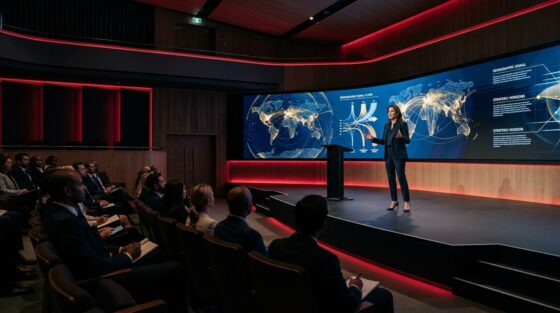


A story by Andrea Lobo Niembro & Ivan Babic
As we enter this new decade of the 20’s, every single institution is exposed to the pressure of deep revisions to adapt to a new set of rising beliefs. Ecology, diversity, flexibility, transparency, human-rights, freedom and happiness. These are now, more than ever, at the center of our decisions as consumers and citizens in general.
Today, education, medicine, communications and social paradigms are being revised, why don’t we do the same with our political systems? Often referred by many authors as “the least bad form of government we know”, Democracy needs to be adapted to the new times we’re living in. Starting with the following…
We need to establish KPI’s
First of all, we need to reframe the way social contracts are written. The so-called “constitutions” should be translated into Key Performance Indicators (KPI’s) and agreed upon, the same way it happens inside any corporation. How can we tell if we’re heading into the right direction if we don’t even have common ground, objective metrics, and a shared vision about where we want to go?

At any given corporation, the KPI’s are clear at all levels. Every employee, including the CEO, is continuously evaluated based on the expectations of the stakeholders for that position. SMART goals are setup jointly every year, and revisited every quarter against demonstrable results, with data.
Can you think of a corporation where the newly elected CEO, who promised an incredible double-digit growth in order to be appointed in that position, fails to deliver month after month without any consequence? Should we wait 4–6 years, in order to get rid of that incompetent liar?
In democracy, literally translated from the Greek as “rule by people”, we should all be accountable. We need to empower citizens as the stakeholders of our wellbeing and continuously evaluate everyone through time, based on specific KPI’s previously defined and agreed upon in a holistic way. And technology is allowing us to do that more and more: directly, and with no need for middlemen nor lobbyists. So…
We should get rid of intermediaries
As technology evolves, one of the biggest impacts in economic and social structures is the less dependence on intermediaries. We can now buy our vegetables directly from a farm without leaving our homes, get access to loans without talking to any bank, get informed, peer-to-peer, without the agenda setting of old-time information monopolies.
Following the same approach, shouldn’t we get rid of congresses, parliaments and assemblies, and embark our citizens into crowdsourcing? The future of a real participatory democracy relies on the possibility of exerting, in real-time, our influence in decisions through the technology in our hands.
Democracy should be seen as a continuous experiment, as stated by Professor Alex Tan, and should be managed through a Lean/Agile approach. Therefore, every initiative needs to be treated as a hypothesis: some will be confirmed by results, others need learning and adjustments after rounds of iteration, and others need to be closed forever, taking all the possible learnings from them.
We need to move towards a Return-On-Information model, the reinterpretation of the acronym ROI. Everything and everyone should be continuously assessed based on results compared to the agreed KPI’s. With great power comes great responsibility, so we need to set the basis for the evaluation of everyone, including us: the citizens. But…
Are we really equal?
This is probably the most controversial point, currently under a profound revision in many societies. Have we really been “created equal”? Or have we “evolved differently”? Should we award behaviors adjusted to the norm? Or should we embrace and celebrate diversity at all levels?

The fact that we deserve equal rights, just because we’re humans, and regardless of gender, skin color, income, beliefs, or sexual preferences doesn’t necessarily mean we are equal at all. Au contraire, every scientific discovery points out diversity as one of the core tools for the survival of the species.

We are embracing diversity of intelligences and talents in our education systems, thanks to the work of people like Howard Gardner and Sir Ken Robinson. Platforms as Khan Academy are pushing societies towards the acceptance of different learning paces, while adopting the revolutionary “flipped classroom” concept. Every corporation worldwide is being pushed towards inclusion, as a proven competitive advantage in executive boards, and the positive impact of diversity on business results.
As pointed by our good friend, Joaquín Núñez Quincot, in many of our late-night discussions: we need a system to evaluate the quality of the decisions taken by each one of us. We need some kind of Democratic Index, a personal weighing for each voter, based on the quality of his/her previous decisions.
Take a moment to think about it. If we have clear KPI’s, agreed by all of us and direct participation with no intermediaries, not only the projects and politicians should be measured in terms of success and failure, but every citizen’s ability to make those decisions. Did it go well and did the results surpass the objectives? Then you get extra democratic points. Did you support a project that lead to failure or didn’t bring the expected results? Then the system takes away some of your democratic points, so next time your impact will be (gladly?) minor.
In this new era of big data, artificial intelligence, and universal access to information, shouldn’t we all be accountable for our decisions? Shouldn’t our good or bad choices be pointed out as a core differentiator for our democratic weight? To do so, we need to see beyond the old concept of equality, and move towards justice and inclusion. And, of course…
We need to be well informed
It’s incredible that, while we expected the internet to give us universal access to knowledge, it also gave voice to a legion of idiots, as stated by Professor Umberto Eco. We need to separate the truth from the false and the facts from the opinions, in order to get well informed in this new era. Remember as you read this: the “flat earthers” is a movement gaining new followers every day, and they vote too!
There’s a never-ending tension between our freedom of speech and our right to be well informed. And the main problem is that we are granting those rights to people who don’t even exist. Social media platforms are full of fake accounts, artificial bots, anonymous trolls and liars, manipulating the public opinion, attacking initiatives, generating fake news and trends, insulting and defaming other people. We are also trapped in the “serve & search” algorithms of every digital platform, and the largely studied Echo Chamber effect.
We need to understand that platforms like Google and Facebook are private businesses, who respond to a few stakeholders based on financial profit. Societies need to build their own platforms, based on the free flow of information, with secured systems to identify and protect our personal data, a digital unique ID for each one of us, linked to a real living person. We need to implement Prediction Markets, a very interesting discipline used successfully in many industries, and transform it into democratic, real-time, online tools.

There is no democracy without education
And no education without exerting our right to be properly informed. Ergo, the future of our democracies is inextricably linked to the future of our education, communication and information systems.
As any good parent will tell you, democracies, as they are conceived nowadays, don’t even work within our families. If the majority of the population (our kids at home) vote for chocolate for lunch, not taking baths every day, nor going to school; those may be popular ideas, but not good in the long term, when assessed against the expected results for the greater good. If you follow democracy, without revisiting its principles, you may be very popular, while breeding a bunch of lazy, smelly, dumb kids.
Can we teach democracy? Can we teach people how to be critic and make better decisions? Can we reward good behavior and choices in terms of our personal complying to KPI’s, based on the current social contracts we’ve signed? Should we punish bad decisions, so murderers, tax-evaders, mirror sellers, corrupts and bad voters, have consequences, and therefore less impact in our future democratic decisions? Can we teach computers to make those decisions for us? Can we create the algorithm for democracy, and put technology at the service of universal well-being?
Democracies without education are a mere exercise of popularity, the establishment of simple yet often wrong ideas, the breeding stock for populism, fascism, ochlocracy and other deformations of the system. The voice of the people is not sacred, when ignorant, as it can be manipulated easily through low emotions, techniques, algorithms and misbeliefs.
We need to revisit the principles of our democracy. We need to make it more inclusive, ecological, participatory and fair. We need to understand that making good choices is not a natural human talent, but something that needs to be taught and continuously nurtured and assessed. We need to establish democracy as a right and a duty, that needs to be protected, nourished and refined through time.
We need to update our political systems, or else we’ll go back to the authoritarian models that have ruled our societies through time.
We need to defend this exceptional short period of freedom and hope, called Democracy, and not take it for granted.
This is a story of the Futurist Club
By Science of the Time
Written by: Ivan Babic and Andrea Lobo Niembro
Ivan Babic
Ivan Babic, partner in Innovation and Founder at Business as Unusual, international speaker and a great storyteller. You must talk to Ivan if you want to challenge the paradigms of your organization at all levels. Expert in Marketing & Innovation, Entrepreneur and Startups Developer, he has created several methodologies and models applying the principles of the HUMAN-CENTERED approach and DESIGN THINKING to create new ways of doing business.
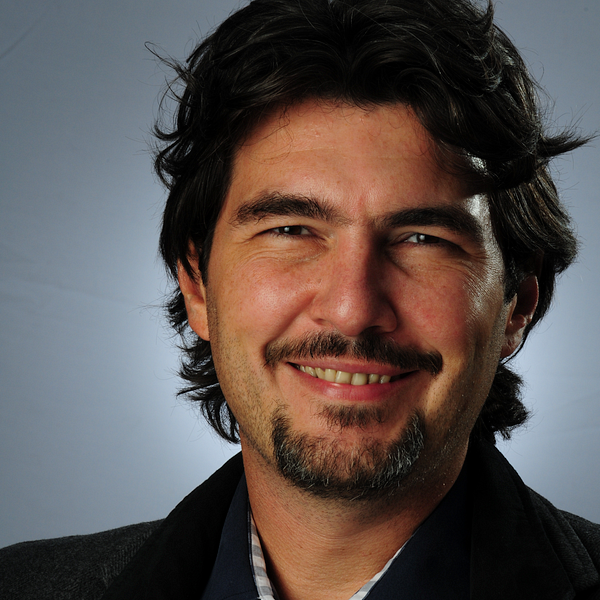
With more than 20 years of a very fun, exciting and successful career in creative industries, and with some failed startups of his own, he learned the hard way the lack of common sense in the business world. “After years working with clients of all sizes in Venezuela, Spain & Mexico, I realized almost everyone was missing the same thing: GOOD IDEAS. Everything seemed to be about finances, structure, technology and communications. They all had the pressure to innovate, but didn’t know where to head to.”
“The value equation happens inside people, it’s a multifactored subjective arithmetical formula. So, creating value is a combination of art and science. The art of understanding people, the way they think and behave, their beliefs and what they need. And the science of generating solutions to those problems, generating hypothesis, validating, iterating and collecting data to support it.”
Creator of ENTREPRENEURAS.COM a comic about the funny world of entrepreneurship & startups, and co-author of BEHAVIORAL TRENDS, a human-centered innovation & value creation game. He studied Communications at Universidad Católica (Venezuela) and is Master in Business Entrepreneurship from the Universidad Politécnica de Madrid (Spain).
His favorite words: WHAT IF…
Andrea Lobo Niembro
There’s people in this world with a natural ability to empathize with others and fully understand them. There’s people that always act from their values and are recalcitrantly congruent even in the challenging times of flexible moral we’re living now. If you want to meet one of those human beings, always looking for ways to do good to people, let me introduce you to Andrea Lobo.
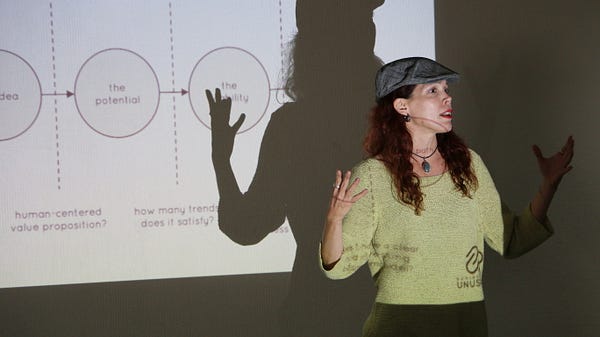
Trendwatcher, Human-Centered specialist and Partner at Business as Unusual, since 2015 she has created a set of BEHAVIORAL TRENDS, full of insights and needstates, to cluster markets from a post-demographic perspective and create real value propositions from there. Her vision over people is changing the way companies understand and apply the HUMAN-CENTERED approach to marketing, innovation, and business planning processes.
Andrea is an expert in Communications, the Human-Centered Approach and Neuro-Linguistic Programming (NLP) which she’s been applying with excellent results among Private Companies, Government, Universities and Non-Profit Organizations. She has created several contents, tools and models based on her skills in empathy-rapport, active listening, persuasion, resilience, social responsibility, creativity, communications, and global vision. These abilities have allowed her to create a unique vision in the analysis of human behaviors and beliefs.
“A new strategic paradigm is needed for business. We need to shift the order of our priorities and start planning everything from a different P: PEOPLE, from a post-demographic perspective.”
Raised in a family with a strong commitment –and life testimony- to human development and social service, her life has been always about actively participating, learning and sharing better ways to help each other, solve problems in creative ways, and promote the innate tendency to become better human beings and consciously live in community.
She’s the “unusual” part of Business as Unusual.

The Coming Wave: Technology, Power, and the 21st Century’s Dilemma
Illuminates the technological currents and frontier systems underpinning this briefing’s foresight analysis.

Click & Grow Smart Garden Connected Indoor Ecosystem
Praktische vertaling van biofiele architectuur en regeneratief wonen: levend groen geïntegreerd in het binnenklimaat.

Doughnut Economics: Seven Ways to Think Like a 21st-Century Economist
Gives critical theoretical grounding to the regenerative models and eco-positive systems documented in this briefing.

Braun Classic Minimalist Bauhaus Analog Watch
Iconisch Dieter Rams-minimalisme: tijdloze proportie en ingetogen luxe als stil statement tegen opzichtige logo-cultuur.

The Art of Gathering: How We Meet and Why It Matters
Provides practical insight into why collective experiences and third places are becoming the new bedrock of brand loyalty.

Ember Temperature Control Smart Mug 2
Slimme thermische precisietechnologie die dagelijkse drinkrituelen transformeert tot een geconditioneerde sensorische ervaring.

Therabody Theragun Mini 2.0 Percussive Therapy
Belichaamt de proactieve fysieke herstel- en saunacultuur die exponentieel groeit binnen hoogwaardige wellness-hospitality.

Audio-Technica AT-LP60XBT Bluetooth Turntable
Verbindt direct met de opkomst van dedicated vinyl listening rooms en analoge acoustic sanctuaries in de hospitality sector.

Philips Somneo Sleep & Circadian Wake-Up Light
Essentiële biohacking technologie voor circadiaan herstel en slaapoptimalisatie, centraal in de nieuwe generatie longevity hotels.

Mission Darkness Mojave Faraday Phone Bag
Fysieke signaalblokkering en anti-tracking technologie voor reizigers die kiezen voor de ultieme luxe van complete digitale onvindbaarheid.