






What is it
Do you love to eat meat, but you know the impacts of the food industry on our climate, and still don’t conform to the way animals are treated? Well, maybe the solution will be in the very near future. Producing “sustainable meat” has moved the universe of startups. “Plant-based Meat” or “Clean Meat” are terms that have been used to describe two different types of innovations that appear as alternatives to traditional meat consumption.
Contrary to what we are used to seeing in conventional agriculture, these two types of meat are not obtained by raising and killing animals. And the answer comes from bioengineering.
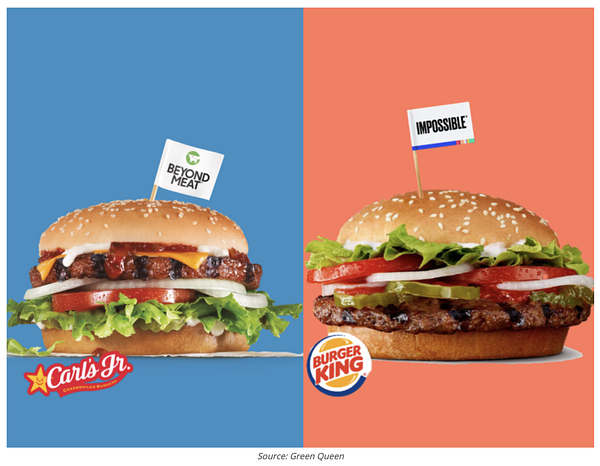
The most famous versions of the Plant-based Meat type are from two food technology companies: Beyond Meat and Impossible Burger. Both companies manufacture “sustainable meat” from the manipulation of vegetable protein cells, without the use of animals, but with the same flavor and texture as traditional meat.
On the other side we have an even more curious version that is being called Clean Meat (also called cellular, cultured, or synthetic meat). Its production starts from the use of cells taken from live animals, without being harmed. Through bioengineering processes, cells are placed in an environment conducive to multiplying and transforming into pieces of muscle tissue and fat that resemble meat from real animals.
Today’s clean meat startups (and we could name here more than ten big startups around the planet) are tackling everything from fried chicken to foie gras, and many look likely to reach supermarkets and restaurants within the next five years.
Why it’s Cool
“A recent study by Oxford University found growing meat in a lab rather than slaughtering animals would significantly reduce greenhouse gases, along with energy and water use. Production also requires a fraction of the land needed to raise cattle. In addition it could be customised to cut the fat content and add nutrients.” BBC
- Environmentally friendly: It is already well known that meat production is part of one of the industries that most damage the environment. The production of clean meat can be one of the solutions to solve the impact on the environment and still allow meat lovers a “green option”
- More nutritious: The option of “sustainable meat” can associate production technology with nutrition, that is, it will be possible to select exactly the nutrients to be ingested.
- Free from slaughter: This alternative will also allow us to reduce the damage and aggression that animals suffer in conventional meat production processes.
- Similarity: Especially when we compare vegetarian or vegan products that seek to replace meat with the Plant-based meat version (which is nothing like what was previously available on the market), we realized that the new option is incomparably more similar to traditional meat. The reproduction of texture and flavor, even appearing to “bleed” in the same way as a hamburger or regular beef, make this “sustainable meat” much more attractive and appetizing for meat lovers.
Why it has Future Growth Potential
We must work together to ensure that the food and agriculture sector is not left behind — and that these efforts contribute towards global food systems that benefit farmers, consumers and the planet. — Bernard Meyerson Chief Innovation Officer, IBM Corporation
Data from the World Economic Forum indicate that by 2050 we will have to feed almost 10 billion people. This information inevitably leads us to the fact that we will need to align technology in production and reduce food waste, in addition to profound changes in our contemporary lifestyle.
When we look at the two alternatives presented, “Clean Meat” has a great challenge to overcome. The idea of meat produced in the laboratory may not seem so appetizing, much less natural. “Clean Meat” companies will have to prove that the benefits of their consumption are not just for animal welfare and the environment, but also for the consumer’s own health.
The arguments may gain more strength after the Covid-19 crisis, because clean meat is made in the laboratory under sterile conditions with less risk of contamination. Beef, on the other hand, is collected in non-sterile slaughterhouses, which means that there is a greater risk of contamination. “Clean meat” is also free of artificial growth hormones and genetic modification, which some suppliers use on their animals to make them grow faster.
At the same time studies at the University of Michigan show that among young people aged 18 to 29 years, there is a greater acceptability and willingness to taste “clean meat”.

The plant based meat version, on the other hand, took the lead in this market race. First, because unlike “clean meat”, it can be consumed by both vegetarians and vegans (who do not consume any animal products). In addition it can benefit from the fact that there are already substitutes for meat of vegetable origin, generating less strangeness.
In addition to the issues involved in each version of sustainable meat, the potential for growth in alternative production to traditional meat is undeniable. this because:
- The meat industry is one of the most impactful on the environment.
- With the advancement of technology, we will be able to produce healthier meats that can meet the nutritional needs we need.
- Clean meat is an alternative to the growing concern about food and the planet, and may represent an alternative to “converted vegetarians” that is, passionate about meat and animals.
Resources:
https://www.sciencemag.org/news/2020/04/lab-grown-meat-starting-feel-real-deal
https://www.bbc.com/news/world-europe-49281111
http://www.fao.org/3/i3437e/i3437e03.pdf
https://www.bbc.com/news/science-environment-46543704
https://ourworldindata.org/food-choice-vs-eating-local
https://www.gfi.org/the-naming-of-clean-meat
https://www.foodandwine.com/news/clean-lab-grown-meat-plant-based-burger
https://www.idtechex.com/en/research-report/plant-based-and-cultured-meat-2020-2030/702
https://www.bbc.com/news/magazine-18813075
http://www3.weforum.org/docs/WEF_Innovation_with_a_Purpose_VF-reduced.pdf
Poore, J., & Nemecek, T. (2018). Reducing food’s environmental impacts through producers and consumers. Science, 360(6392), 987–992.
Weber, C. L., & Matthews, H. S. (2008). Food-miles and the relative climate impacts of food choices in the United States. Environmental Science & Technology.
This is a story of the Futurists Club
By Science of the Time
Written by: Luana Bistane

Luana Bistane is nomad by nature and curious by vocation.
Master student in Culture and Communication at the University of Lisbon, specialist in Creative Economy, at the University Rey Juan Carlos de Madrid and Cultural Manager.
She is a researcher in the fields of trend studies and economic development through Culture and Creative. Believing that monitoring trends allows us to better recognize the contours of the present to prepare for the construction of a better future for all.
Citizen of the world, she is Brazilian, but chose Lisbon as her home. She is co-founder and Director of LadoBe Creative Agency and a senior consultant for the startup Brigde For Billions. With LadoBe Creative it promotes innovation and internationalization of companies, cultural branding, and carries out cultural projects.
In Brazil, she was Executive Director of the Orquestra Sinfônica da Bahia (OSBA), which had the honor of producing a tour of the show “String Concerto and Rhythm Machines”, by the master of Brazilian music, Gilberto Gil.
Believe that a more balanced, fair and sustainable future is possible and work for it!

Doughnut Economics: Seven Ways to Think Like a 21st-Century Economist
Gives critical theoretical grounding to the regenerative models and eco-positive systems documented in this briefing.

Click & Grow Smart Garden Connected Indoor Ecosystem
Praktische vertaling van biofiele architectuur en regeneratief wonen: levend groen geïntegreerd in het binnenklimaat.

The Coming Wave: Technology, Power, and the 21st Century’s Dilemma
Illuminates the technological currents and frontier systems underpinning this briefing’s foresight analysis.

Therabody Theragun Mini 2.0 Percussive Therapy
Belichaamt de proactieve fysieke herstel- en saunacultuur die exponentieel groeit binnen hoogwaardige wellness-hospitality.
Gastrophysics: The New Science of Eating
Deconstructs the neurogastronomy and multi-sensory experiments explored in this culinary foresight signal.

Ember Temperature Control Smart Mug 2
Slimme thermische precisietechnologie die dagelijkse drinkrituelen transformeert tot een geconditioneerde sensorische ervaring.

Kilner Fermentation Set with Silicone Valve (3L)
Essentiële apparatuur voor de culinaire avant-garde en fermentatie-experimenten die de toekomst van smaak definiëren.

LARQ PureVis Self-Cleaning UV-C Insulated Bottle
Onmisbare uitrusting voor de bewuste natuurreiziger en de opkomst van off-grid eco-luxury bestemmingen.

Audio-Technica AT-LP60XBT Bluetooth Turntable
Verbindt direct met de opkomst van dedicated vinyl listening rooms en analoge acoustic sanctuaries in de hospitality sector.

Philips Somneo Sleep & Circadian Wake-Up Light
Essentiële biohacking technologie voor circadiaan herstel en slaapoptimalisatie, centraal in de nieuwe generatie longevity hotels.